
Light Up the Sky
Some thoughts on fame

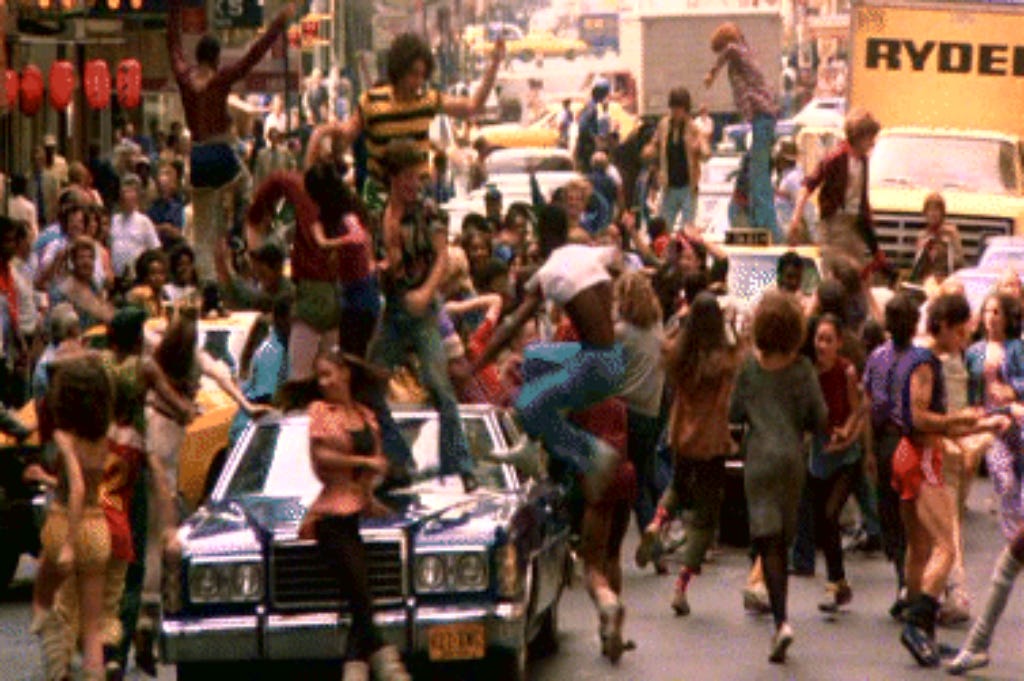
There was a kid I knew slightly towards the end of high school, named Alex. He had a wispy, teenage moustache and a Russian last name. Either he moved to our town fairly late in the game or I just never ran into him until our senior year. But I got to know him a little towards the end, and he was an interesting guy. He played piano and composed music—strange music that sometimes required hitting a range of keys with his whole forearm. His odd music must have come to someone’s attention, because the rights to one of his pieces was bought by a studio, and he was filmed playing it for the movie, Fame, which came out during our senior year. When we all went to see the movie to support Alex, we got to see our friend’s elbows bang down on a piano for one whole second during the opening “audition” montage. That was his moment of Fame.
Perhaps he had some other moments after high school. I have no idea.
I saw the movie again, the summer after my Freshman year of college, during a study abroad program in Oxford, England. It was quite a weird thing to see all of those big, loud, ebullient, multi-ethnic teenagers singing and dancing in the streets of New York, while I was sitting in a little art-house theater in an ancient, English town—a town where, during the day, I was reading about poor, old Jude the Obscure quoting Latin texts to snobby, young scholars in a 14th century pub that I had actually visited.
I’ve been thinking about Fame because the daughter of my dear friend, Dana, was in a high school production last night of…well, something that had the same title as the old movie. I don’t know what it was I saw, exactly. It was certainly not the movie. Not the same story, not the same characters, not the same songs. Part of the title song did show up somewhere, wedged into one of the many, utterly forgettable and shouty musical numbers that had been created for this thing. I hugged the kid after the curtain call and offered up my congratulations, and then came home to think happier thoughts. These are them.
The soundtrack to the old movie is great. I don’t know why all those songs had to be abandoned. Rights issues, I assume. I hope it wasn’t just some geniuses thinking, “Who needs ‘em? We can do better!”
Those songs have always been a part of my life soundtrack. The title song used to come on fairly regularly at P.J Haley’s, the bar where we would go drinking and dancing after our monthly comedy sketch shows in college. There was nothing quite as wonderful as coming down from a successful performance and throwing our hands up in the air on the dance floor, all together, singing along with the lyrics:
I’m going to live forever,
Light up the sky like a flame,
I’m going to make it to heaven,
Baby, remember my name.
I didn’t have any illusions that I was going to be famous—or, at least, not that kind of famous. At a minimum, I knew that if I ever managed some bit of acclaim, it wouldn’t be all roses. Aside from Fame, which had its own warnings, I had seen All That Jazz (far too young). I had seen how ugly, “it’s showtime, folks,” could get, and what could happen when your passion burned your candle not only at both ends, but also in the middle.
I saw that movie again when it played on my college campus. I remember leaving the theater after watching the body-bag zip up over Roy Scheider’s head and hearing Ethel Merman sing, “There’s No Business Like Show Business,” and running, running, running across the quad as fast as I could—not sure why I had to move as fast as I could after seeing all of that, but absolutely certain that I had to.
Another sober warning came from another brush with Fame. There was a young actor in the movie, named Boyd Gaines, who had been in a production of The Rainmaker at the Berkshire Theater Festival, the summer before the movie came out. I was working at the theater as an apprentice. I remember him telling our acting class never to move to New York unless we had a job in hand, because otherwise, the city would kick our asses and send us home. A year later, there he was on the big screen, playing a recent graduate of the performing arts high school who could only find work as a waiter. He provided wise warnings to us younger folk in fictional and non-fictional settings, which I thought was damned nice of him.
What became of him in subsequent years, I don’t know.
It’s funny—all through college and even during my theater-company years, we used to joke about people being “the kids from Fame.” To us, it meant happy, peppy, annoyingly passionate and committed young people liable to drop everything to go dance in the street. But, of course, if you’ve ever seen the actual movie about aspiring actors, singers, and dancers in New York’s High School for Performing Arts, you know that the movie is filled with 1970s drear and despair and dashed dreams. And also, to be fair, some dancing in the street.
As I retreated from on-stage to back-stage, to my more natural role as a writer and occasionally a director, my ideas about The Work, what it meant, what it demanded, what I owed it, and what I thought it owed me, all changed. I knew it wasn’t about ego and recognition; it was about work and craft; it was about finding the right words and the right actions to convey something honest and true about the world, or at least about how it felt, at that moment, to be in the world.
I did not expect to see my name in lights. But I did expect something. It remained inchoate and unsaid, even in the privacy of my skull—possibly because I didn’t believe in it hard enough; possibly because I knew it would take more out of me than I was going to be willing to give. I don’t know. I thought there would be some kind of a life and a living and a reputation, though, if I did good work.
I was mistaken.
I gave it my 20s and more than half of my 30s, and in the end, I decided it was enough.
Is there still something in me, though—something restless in my otherwise stoic and quiet and introverted self that wants attention and affirmation, even this late in life? Probably. It didn’t take long for me to want some kind of audience again after walking away from the theater company. I worked for less than a year as a curriculum writer before I leapt at the invitation to start leading teacher workshops. Even a hostile audience—and there are few audiences more hostile than teachers forced to attend professional development—was worth playing to. And when I could bring them something they appreciated on a day when they expected nothing but drudgery, that was a really good day.
I don’t get to do that as much, these days, but it’s a treat when I do. I was in India for work two months ago, and I had the chance to give a 20-minute talk on effective assessment techniques. Dry stuff, you would think, but it generated 20 minutes of audience questions afterwards, which drifted out into lunch.
It’s gratifying, when you’re mostly an isolated ink-stained-wretch, to get some genuine, human contact and response. Did I “light up the sky like a flame?” Emphatically not. But a light in somebody’s eyes is pretty good.
But do you see the slippage there? It’s the work that matters, of course, but you still want to see that the work did matter—to someone—and that’s where ego creeps in. I remember having a quote from the Bhagavad Gita up on my wall, years ago, copied out from one of J.D. Salinger’s books, about how you have the right to your work but not to the fruits of your work. It’s a hard lesson to keep in mind.
Do I still try to write for an audience? Kind of. There’s you, out there in cyberspace. I have these Substack posts that I write every Friday—every single Friday—whether anybody reads them or not. But if I was doing it just for Likes and Comments, I would have stopped a long time ago. because I don’t get many of either.
And I have the novels I occasionally write—no need for renting a stage and auditioning actors and raising thousands of dollars anymore, just to tell a story. It costs me a little to have them edited and published, and I tend to make a tiny sliver of money on them before they recede from attention. My tens of readers seem to enjoy them. But again, if I was doing it solely for attention, it would be a monumental waste of effort.
Is it just the desire to communicate—the need to communicate—to shout something out into the void in order to hear my own voice? Is it what Beckett says? “Nothing to express, nothing with which to express, nothing from which to express, no power to express, no desire to express, together with the obligation to express"?
I don’t know. I really don’t. But I keep doing it.
I’m not going to live forever or learn how to fly, but that old soundtrack still plays in my head—even without my kids-from-Fame friends with me on the dance floor. I still sing the old songs, even out here on my own.
I still sing the body electric. And just like the kids promise to do at their graduation ceremony, as they face a daunting and uncertain future, I’ll serenade Venus, I'll serenade Mars, and I'll burn with the fire of ten million stars. What else can you do with the fire inside you?
Because we do still have fire inside us, even if we’ve been burning for a long time. Even if we feel, sometimes, that we’re only old coals now, slowly losing color and heat. It’s not over yet. There is more yet to burn before we’re done here.
And in time, and in time, we will all be stars.
Dear ink stained wretch. Keep writing.
I’m always here listening, and you always light up my sky. And…..
“What I'm tryin' to say isn't really new
It's just the things that happen to me
When I'm reminded of you”