
Revisiting Dedication
Thinking differently about the festival of lights

I wrote about this a couple of years ago and wanted to take another look at it ahead of Chanukah, which starts next week.
The joke about Chanukah among MOT (members of the tribe) is that it comes early or it comes late, but it never seems to come on time. I’m not even sure what “on time” means for the holiday. I don’t think it exists. It’s either early relative to Christmas or it’s late. That’s just life for us here in the western world.
The festival is all about celebrating light in dark times, and since the solstice this year falls during the eight-day holiday, I’d say Chanukah is pretty “on time” this year. The sixth night, when almost all of the candles are lit, will hit on the shortest and darkest day of the year. That seems appropriate.
Making Meaning
Chanukah can be a strange holiday here in America, unless you’re a child or you have children. Once the gift giving and dreidel playing is out of your life, it’s hard to know what to do with the event, if anything. It’s hard not to get overwhelmed by and swept up in the Christmas of it all. Which is fine. I’m used to dealing with that. But if you can get past the “Eight Crazy Nights” aspect of Chanukah, there is something serious in there that’s worth making use of as an adult.
The miracle part (one night’s worth of oil lasted for eight nights!) is a clever way to engage children. It was also, historically, a clever way to put local haters off the scent. Don’t worry, fellas—it’s not about freedom of religion or preserving our culture in the face of adversity or conformity. It’s just about candles and miracles. I’ve got a thingie in the window for everyone to see. Candles. That’s all this is.
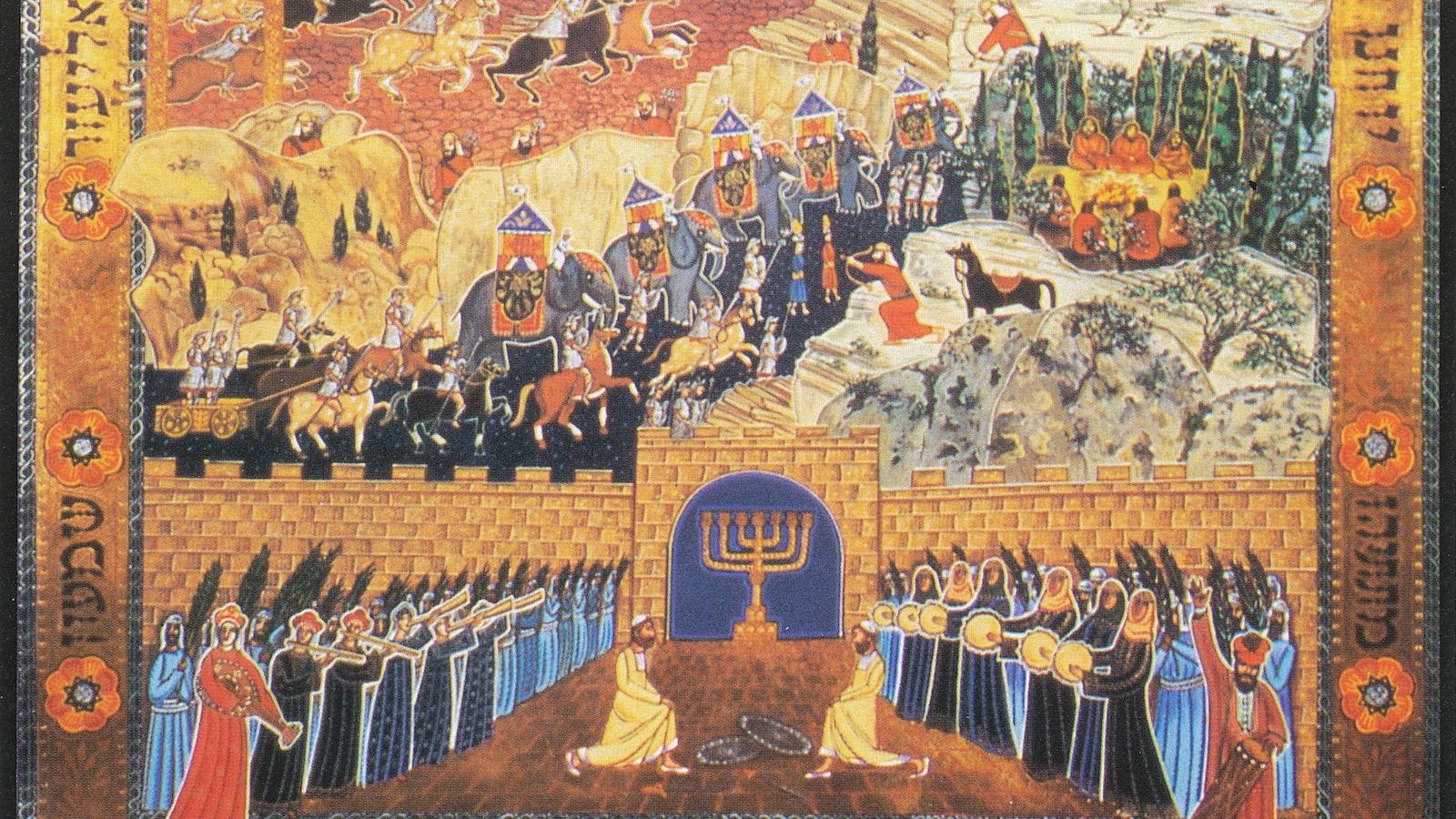
But that’s not true. There’s more to it. The holiday is meant to be about dedication. The historical event it commemorates is the reclamation of the Israelites’ temple from the Persians who had taken it over in the wake of Alexander the Great’s death, and who had desecrated it with idols and pigs’ blood. “Reclamation,” in this story, involves a local warlord and his family leading an armed revolt against the occupying government and driving them out of the country. You can see why Jews living precariously under Medieval kings and the Catholic church might not want to celebrate that event out loud.
Anyway. The Israelites cleaned the temple, purified it, and re-sanctified it. They reclaimed their traditions and rededicated themselves to what they held true. They resisted assimilation into the Hellenistic world, which pretty much was the world at the time. They decided to hold onto what they believed in, and they re-dedicated themselves to keeping it alive. That’s the story.
We adults could use the occasion to think about the idea of dedication and reclamation in our own lives. That’s what people in the Jewish Renewal movement did with the holiday, back when I used to read about them. I always thought it was a nice approach, though I never did anything with it.
So, again this year, with my two sons fully grown and not expecting gifts and doodads every night, I want to try to do something more real with the holiday. I’m going to try to use each candle—one each night—as a way to think about some aspect of my life that could use some focus and dedication.
And if I write it down here, maybe I’ll make myself do it.
Counting the Candles
As I tried to do a couple of years ago, I’m going to start close and then work my way outward. The first candle on Sunday night will be about my past. What dreams, hopes, and beliefs from childhood or youth have I let slide or allowed myself to lose? What do I want to re-dedicate myself to in the coming year? What old mission statement might need new marketing? That will be my focus for the first night.
The second night will be about present-day me: mental health, physical health, spiritual health. What am I not paying attention to while focused on wife, children, work, etc.? That’s an easy one to some degree. I already know the answers: eat better, exercise more, lose weight, meditate. The usual New Year’s Resolution stuff. It will probably fall by the wayside before anything else, but…maybe I can try to do better?
I know, it’s the hope that kills you. But hope is a stubborn old thing.
For the third night, I’ll focus on my future. What things require commitment and re-dedication from me as I look ahead and think about what I want my third act to look like? What did I say to myself when I turned 60 and then promptly forget when things got busy?
So much. Let’s try again.
The fourth candle will be for my family. With my wife still struggling with Long Covid and its fatigue and brain fog, with one son still in school and the other trying to establish himself in work and adult life, family is always front of mind for me. But dedication to other people’s needs has to mean more than doing what I think is best; it has to mean listening and learning and honoring what they say they need. Am I listening as well as I could be?
The fifth candle is for my friends. I'm an aging male, typical of my species in my lack of care and feeding of close friendships, especially with other men. I could do better. I want to try to do better. I mentioned this in last week’s post. Loneliness can be a killer. Being silent or un-forthcoming in a friendly but superficial way isn't much better.
The sixth candle is for the larger community: the town I live in, the company I work for. This one might be tricky if I think beyond work, which of course consumes most of my time. I just stepped down from the school board I served on after eight years of service. And I’m no longer volunteering at the alternative school I was working at once a week. I can’t be of use to them right now in the limited time I can make available to them. So, I’ve pulled back a bit. What could I be doing?
The seventh candle is for my country.
Yeesh. This one is hard. What does it mean to re-dedicate myself to this country, in these fraught and frightening, more-than-occasionally stupid times? What do I owe? What can I do that’s of any real use or meaning, aside from posting angry comments online and going to the occasional protest?
Good thing I don’t have to think about that until next week.
L’Dor Vador
With the final candle, since it’s a Jewish holiday, I should think about the Jewish people—at home and worldwide. As an American who grew up in the 60s and 70s, it’s not something I ever really worried about or felt I had to. I grew up safe and mostly ambivalent. Bad stuff was in the past, mostly. And it wasn’t something I talked about out loud. It took me until my 40s to feel comfortable saying “I’m a Jew" instead of something like “I’m a Jewish person.”
If I owe my family and I owe my local community and I owe my country, what do I owe my tribe? And who, exactly, am I talking about?
Being the stubborn old remnant of an ancient people, we have an interesting relationship with time. When Moses encounters God in the form of a burning bush and asks who he is, the voice says, “Ehyeh asher ehyeh,” which we often translate as, “I am what I am.” But the imperfect verb, “ehyeh,” can also be the used for the future tense (and, some argue, the past tense as well), so it could just as easily be, “I will be what I was,” or “I am what I will be,” and so on.
We like to talk about our own past in the present tense, because we hold it tightly (some say too tightly). At the Passover seder, we talk repeatedly about “when I was a slave in Egypt.” When we talk about the giving of the Ten Commandments at Mount Sinai, we say that all Jews, from all times, were present—past, present, and future. When we celebrate our young people become adults in B’nai Mitzvah ceremonies, we often take a moment to hand the Torah from parent to child, or even from grandparent to parent to child. We talk about preserving things l’dor vador—from generation to generation.
You get the idea. Much changes, and yet there is continuity. The People is not just the people around me; it’s also the people behind me and the people yet to come. So, what do I owe them?
Light One Candle
Will I do a better job this year of thinking about all these things and then doing something about what I think? We’ll see.
Resolutions that expect you to magically become someone you’re not (someone “better”) are bound to fail. We can only be who we are, and who we are has to be enough. But maybe if we focus on the best parts of ourselves—even if some of those parts lie latent or hidden—maybe if we dedicate ourselves to being ourselves, in the best way possible, we can have a better, stronger, and happier new year.
Having a separate approach for each of the eight nights, instead of lumping all eight together as one festival? Interesting. Will ponder that tonight as I light the menorah.
As for "early" or "late," to me Chanukah always arrives right on time -- the 25th of Kislev.
Oh, I love this Andrew, such a good idea to be thoughtful about each night, each candle. I need to make a cheat sheet though so I can see the list easily and write it in my calendar lol.