
Shorter Sharper Saner
My dilettantish proposal for legislative reform

The Problem
I wonder sometimes if the enchantment with strongmen that we’re seeing is happening not because of the power and effectiveness of anyone offering themselves to us, but just because the audience has gotten bored with the show.
It shouldn’t be a surprise, I guess. It’s a pretty old show. Maybe it’s gotten stale.
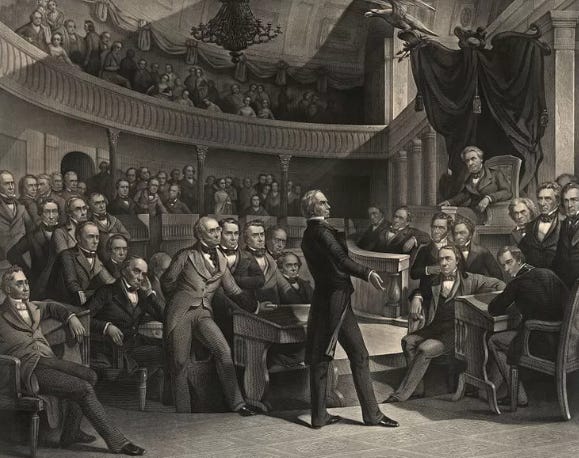
Our democratic norms and practices were formed a long time ago, during the Enlightenment era in the 18th century, and they haven’t been updated much since then. Our founders valued debate and discussion, logic and rhetoric, rational persuasion, and above all, time. The Battle of Lexington and Concord, the first real armed conflict between the British and the American colonists, occurred in April of 1776. Terrible crisis, right? But Independence was declared over a year later. We took our sweet time sending the right people to Philadelphia and letting them talk and talk and talk before deciding what to do.
The world moved more slowly back then. Still, not everyone loved all that talk. Some people wanted faster and more decisive action—John Adams among them.
But there was time. Time for Thomas Paine to write “Common Sense” and time for colonists to read it and argue about it. Time to write a declaration and revise it and vote on it.
Later, there was time to create a Senate deliberately constructed to serve as the “cooling saucer” of congressional argument, slowing things down and making sure the right decisions were being made.
The entire idea of representative democracy assumes that we have time for wise decisions to be made: time for citizens to argue amongst ourselves; time for congressmen to hold townhall meetings and hear from constituents; time for Congress to meet and debate and discuss; time for drafts to go through various committees to gain consensus or at least majority approval. We take our time and, in the end, we come up with legislation that does the most good for the most people and is approved by most members of the government. That’s the theory, anyway.
I know it rarely worked that way in reality, but now I fear it never works. I think our sense of time is one reason. We expect things to happen in an instant, and if we are forced to wait—for anything—we become irritated.
Is Congressional debate still seen as a political and societal good? Or is it just a bunch of nonsense that gets in the way of Things Getting Done? Do we gaze over at places like China with envy, because their leadership can simply decree things and make them happen? Did some of us vote—thrice—for Donald Trump explicitly because he came from outside government and had no patience for the ancient and creaky niceties of debate and discussion?
Do we just want Hulk to smash things and Iron Man to fix things, and trust that they’ll smash and fix the right things in the right ways on our behalf? Is “just do stuff” our new national creed?
Anne Applebaum, speaking recently to a European audience, had this warning about where we’ve drifted:
We need to acknowledge what is happening in Washington now, because the United States under this administration is no longer interested in leading democratic coalitions, against Russia or anyone else. Democracy is no longer at the center of US foreign policy, or of America’s identity. Instead, Donald Trump has begun to align US foreign and domestic policies with the values and practices of the autocratic world.
If Democrats—and some Independents and disillusioned Republicans—want to drive a compelling pro-democracy movement to change this trend, it’s exactly those “values and practices” that we have to start paying attention to. We have to start seeing those things as desirable again, not as obstacles.
What might that look like?
A Solution
It’s hard for ordinary people to know what’s really going on in Congress. There are reasons for that. Congress has almost entirely given up on advancing smaller pieces of legislation that are discrete and easy to understand. These days, they tend to roll everything they care about into one, annual omnibus bill: a “single piece of legislation that packages together multiple smaller bills—often including all or most of the annual appropriations (spending) bills—into one massive bill that is voted on as a single package.”
Nobody feels able to build a large majority for anything anymore, so they just try to force it all through reconciliation. Give up on building consensus; just see how much you can get away with.
The level of disengagement is intense—voter disengagement from what is being proposed and congressional disengagement from what they’re even voting for. The president wants X, Y, and Z. He has a short window in which to advance his agenda before having to run for re-election or become a lame duck. So…ram it through.
I propose we move in the opposite direction.
The reform I’m proposing would not require a constitutional amendment or even a new law. It would simply be a change in practice. If/when the Democrats regain control of a congressional majority, I propose that they give up on omnibus bills and go back to smaller, more tightly focused bills, even at the risk of getting less stuff passed. Re-engage voters in democratic processes and democratic values. Insist on our engagement.
Instead of ramming through one giant bill and then doing nothing but podcasts and cable hits all year, Congress could put smaller and more discretely defined bills up every month. Seriously: one a month. (I’d love it to be one per week, but I know that’s asking a lot.) Bring the bill to the floor in Week One and post it, with a straightforward explanation, online. Let partisans post their arguments for and against. Open the floodgates and let The People argue about it on social media to their heart’s content. Improve senators’ and representatives’ websites to allow for simple public opinion voting: yea or nay, plus room for an explanation. Let Congress hear directly from voters, every month, on one clearly defined issue. Then debate it on the floor of Congress, vote on it, and move on to the next one.
Why do this? There are a few reasons:
It makes it very clear what is being discussed and voted on. No more hiding evil shit inside giant tomes of legislation.
It keeps the energy of democracy tingling and popping, alive with discussion within Congress and between government and voters—something new all the time.
It keeps the public actively engaged by presenting smaller targets on a rolling basis all year long, asking for their involvement and their opinions.
It forces our congressional representatives to put their names on the record for or against clearly defined issues. No more claiming you didn’t know what you were voting for—or against.
It creates a tighter bond of accountability between constituents and their representatives. Are they really listening? Are they doing what we ask? When they disagree, are they educating and persuading us?
It takes giant and complex issues and breaks them into smaller components that we can explore and try to compromise or gain consensus on.
Who knows? It might just lead to solutions that most of the public can get behind, instead of the minority party feeling oppressed and wanting to wipe out whatever the last administration passed.
Are You Crazy?
Yes, probably. This is probably impractical for at least a dozen reasons, and there are all kinds of political incentives for Congress doing things the way they do them and not nearly enough incentives to change them. I get it.
But we move faster now. We just do. We learn about what’s happening at lightspeed now, from every corner of the world. We form opinions instantly—too instantly, with too little real information and too much partisan bickering. Why can’t we create systems to connect us better to the people we select to represent our needs? Why can’t we revise our systems of debate and decision-making to better reflect our pace of life, while still protecting some level of debate and deliberation?
Argue more, faster, more often…but about smaller things.
If you believe you’re meant to be a passive audience in the show of American politics, you’re going to start insisting that the show be loud and entertaining. And that’s exactly what we do insist on, more and more every year. But democracy was never meant to be a show for us to watch. It was meant to be an embodied way of living, from families to neighborhoods to communities to states, all the way to Washington. That was exactly what de Tocqueville found unique about us—that habit of mind we developed, that way we had of behaving with each other across a wide variety of interactions, that made us truly different from other people in the world.
We’ve lost a lot of that. We’ve lost more than good civics classes; we’ve lost the thick web of clubs and organizations whose daily work runs on the norms and processes of self-government and democratic decision making. We need re-engage with it and re-learn it.
If we don’t live it ourselves, we won’t demand it of our representatives. If we don’t care enough to work the questions, all we’ll care about are instant answers.
And someone will always be willing to give us those.
Brilliant, and worth a try, but unlikely to happen.
How I'd like to slow down politics and de-escalate its warfare aspect is also not going to happen: Do away with political parties. Instead of electing people according to party affiliation, we would elect people according to who those people are. In Congress there would be no more turning to the sidelines to see what the "party line" is on any given issue; instead, the elected representatives, and the voters too, would have to think for themselves.
Blind allegiance, whether to an elected individual or to a political party, is part of the problem.
Very interesting idea which will be lost in the current babble