
The True Story
An oxymoron for the ages


There is no such thing as a true story.
Hear me out…
A story is a structured and organized arrangement of events. If the events and characters have been invented by an author, then obviously it is not “true.” That’s easy. But even if the story is an attempt to capture real events that occurred to real people in the real word, the very act of structuring and organizing the whole thing detaches the narrative from the “truth,” at least to some degree.
The structure of a story has its own story to tell.
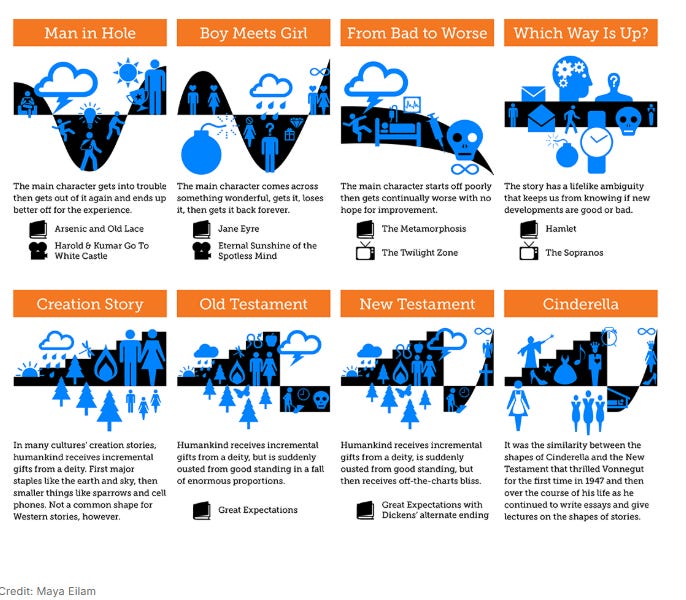
Kurt Vonnegut used to love talking about this. You can see a clip of one of his presentations here. He thought there was a limited number of shapes or structures available for storytelling, and that all the stories we know fit into one of those shapes. You could graph any story on an X and a Y axis, with the vertical representing good or bad fortune and the horizontal representing time. Plot any story you know on these axes, and you’ll start seeing the same trend lines over and over again:
Vonnegut himself had wrestled with a “true story” he wanted to tell. He struggled for years, trying to figure out what shape his tale should take. He wanted to recount what had happened to him as a prisoner of war in the German city of Dresden during World War II. He wanted to share what it had been like to witness, from the ground, the horrific fire-bombing of the city by the American Air Force— a story that no one had wanted to talk about for a long time. It was a traumatic, and strange, and woeful, and sometimes weirdly funny time of his life. How on earth could he capture it all in a way that made sense?
In the end, the only way he was able to express what those events had felt like and what they had meant to him was to embed the events in a larger story that included not only the war but also the decades after it, a story that involved time travel and a race of one-eyed aliens shaped like bathroom plungers. That wild, chaotic fiction enabled him to confront and express something at the heart of the events that felt true to him. And that novel, Slaughterhouse-5, made his career and established him as an important writer.
Telling stories is how we make sense of the world.
What happens when you set out to tell a “true story” without any Vonnegut-ian flights of fancy? Just the facts: true crime, biography, history, something like that. Well, even then, you’re going to structure, arrange, and edit events—not to lie, necessarily, but to create a compelling (or at least a comprehensible) narrative. Even if you want to take a “do no harm” position as a writer, you still have to decide where to start your story and where to end it. Life, after all, has a habit of going on and on and on. Good things happen, bad things happen, things we don’t understand until years later—a lot happens! What does it all mean? It depends on how you package it. Where you decide to start and where you decide to stop will determine which of Vonnegut’s shapes your story takes.
A teacher once explained it to me by using the example of Sunrise at Campobello, a 1958 play about Franklin D. Roosevelt’s life. Roosevelt is (currently) the longest-serving president in American history. He presided over both the Great Depression and World War II. He died at 63. How do you capture all of that in two hours of stage time?
Well…you don’t. Not if you want to adhere to Aristotelian dramatic unities. Maybe in a movie you can jump around from year to year and place to place effectively, but in a play, it’s usually better to focus your time on a more limited set of characters and conflicts and events—a smaller part that says something true and important about the larger whole.
So, what did the playwright, Dore Schary, decide to do? Did he dramatize the worldwide economic depression? Roosevelt’s response to the attack on Pearl Harbor? No—he focused on the story of Roosevelt’s early struggle with polio. He told the story of a privileged and spoiled young man who thinks the world is his for the taking, and how the onset of a terrible disease forces him to reckon with weakness, with limitation, and with vulnerability. The inconsequential young man who walks onto the stage at the beginning is transformed through suffering into someone both tougher and more empathetic—someone who understands pain and fear, and who is ready, in a way he couldn’t have been before, to become a fighter for other people. The play (which fits Vonnegut’s “Man in Hole” structure, for those keeping score) is about how Roosevelt became Roosevelt. It’s a great story.
Are the events true? As far as I know, they are. Are they the only things that happened to Roosevelt during that period? Of course not. A thousand, thousand things happened. Schary chose some of them, omitted others, and arranged it all to condense events into two hours of entertainment. He told a story.
Someone else might tell a very different story, about some other events in that man’s life.
Someone else might tell a very different story about the same events in that man’s life.
My father was a law school professor, and he ran mock trials every year, to which K-12 students were often invited—sometimes to watch as spectators, sometimes to serve as jurors. The law students worked from playbooks of evidence and depositions, so that the same trial could be re-staged every year.
As the professor’s kid, I got to see the same trial done multiple times. And it was different, every time. Wildly different.
Why? Because, just as in real life, the law students had access to all of the potential evidence—many depositions from possible witnesses and many pieces of physical evidence. They had to decide what to use and what to leave untouched. Just as Dore Shary had to do, those law students had to figure out what story they wanted to tell from the raw material of life. They weren’t trying to be objective journalists or historians; they were trying to convince a jury that their client was guilty or innocent. They had an agenda, and that agenda informed which witnesses to call (or ignore), which artifacts to show the jury (or suppress), and what order to present it all in.
Because of that, I saw a fire insurance case presented once as a scientific inquiry into arson and once as a story about a jilted and scorned lover. If I had seen the case presented seven more times, I would have seen seven other stories.
Everyone selects, suppresses, and arranges events and facts to tell a story about the world. Sometimes it’s a public story that advances a particular agenda; sometimes it’s a private story that simply confirms a person’s worldview. Everybody does it.
The world is too big to take in, all of it, all at once. To know the actual truth, you’d have to see all the things, from all the available perspectives. You’d have to understand what caused all of the things and what all of the things caused in their turn. You’d have to be able to see everything, all at once, the way Vonnegut’s Tralfamadorian aliens do, or the way God does.
Whether Tralfamadorians or God are true is up to you.
Excellent. This one belongs in the "Best of Ordover on Substack" collection.
I love everything about this essay. Thank you for sharing!