
Why Must School be an Alien Planet?
So little of what we ask students to do resembles what the adult world will ask of them.


Your Ways Are Strange to Us
Schools are weird. Most of us don't think about how weird they are, because we’ve spent so many years inside of schools that we take them for granted. But trust me; they are weird places—almost alien places. They don’t look like or work like anything else in our world. They structure time differently. They organize people and activities differently. They expect behaviors that almost no one else expects. And yet they are where we send our children in order to prepare them for the “real world.”
One reason for the weirdness is that our schools were designed, back in the mid-1800s, to resemble and to prepare people for life in industrial-era factories. That’s why school was structured the way it was. It took people from all of the country, and then all over the world—all kinds of spiky and different people—and it processed them into well-behaved “Americans” ready for factory work. Which was fine, perhaps, in the 1880s (or not). But if your adult life in the late 2020s is not going to be spent inside an old-fashioned, assembly-line factory, where obedience and conformity are the highest values, then an American school can be a very strange place to spend your time, no matter how much its staff tries to dress it up and call it Progressive.
Consider, just for a start: Students spend every second of their day surrounded by other children who are the same age as they are. This will never happen again outside of school, but it is an ironclad rule when you’re in school. It is relentless. Every year, all year long, you will sit in a room with people selected solely because of their birthdays, in what Sir Ken Robinson referred to as “batch processing by age.”
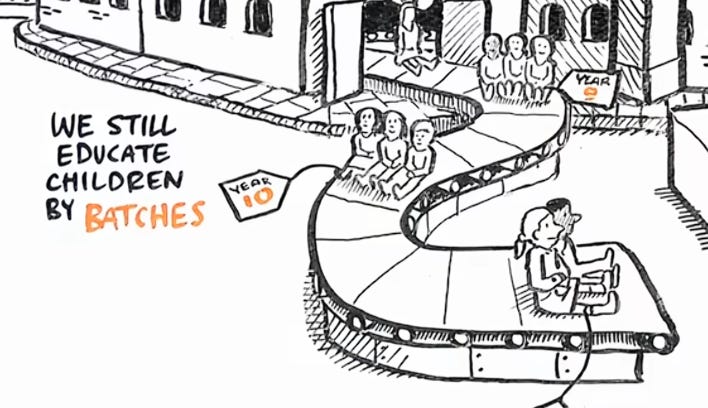
And you can’t escape the crush of those children. You spend your entire school day in their presence. It is shockingly, constantly public. The only private moment you get is when you go to the bathroom—something you must ask permission to do, permission which is often denied because the authority figure thinks she knows the petitioner’s bladder better than the petitioner does, or because she suspects he is looking to commit some kind of mischief.
Once you leave school, how likely is it that you will spend your days like that? I hope not very likely.
So, it is a constantly public, constantly visible life, but within it, you are told again and again that you must never ask your neighbors for assistance or dialogue or an opinion, even though they are RIGHT THERE ALL THE TIME. You must always do your own work, unless it has been designated as “group work” time (which, perversely, is exactly when you wish you could be left alone). Most of the time—and more and more as you get older—learning is not considered real unless it is accomplished alone. The adults believe that you cannot know something unless you have figured it out all by yourself. Your work product will not be accepted if there is a chance that a second mind has contributed to it. You can only be as good as what you can do alone.
Once you leave school, how likely is it that your work life will follow those rules?
Students move into middle and then high school, where their day is cut up and fragmented in wildly artificial ways. A bell rings, and they are told to start thinking about Subject A and nothing but Subject A. Within an hour, the bell rings again, and students are expected to stop thinking about that subject immediately and to move to another room where they must now think about Subject B. This repeats and repeats until exhaustion sets in or the final bell of the day rings, allowing them to go home and (finally) think about whatever interests them, in whatever increments of time are meaningful to them.
Do you think only of one thing at a time, every day, each thing at the same time every day? Are you prohibited from deciding how and when to attack your work, and what to focus on first? Are you punished for letting your thoughts wander, kept from ever connecting disparate ideas or genres? Is your life dictated by a bell ringing every hour? Would you be happy in a job like that?
No? But why not? It’s exactly what school trained you for.
Even prisoners, who live by bells and rules, are left more or less alone in their minds to think their own thoughts.
A Rubric for the Real World
Look, I understand why things are the way they are. I’ve been in this game for a while. I know why school time is structured the way it is, and it’s not for the benefit of a child’s developing mind; it’s for the convenience of the adults who run the building. And I know why “do your own work” matters so desperately in school. We may say that the purpose of a school is educate and liberate young minds or to pass on the collective wisdom of our civilization, but the real social function of a school is to sort and rank young people so that we can make decisions about where they go and what they do next.
In theory, it should be a victory if everyone in the room reaches the desired level of understanding and proficiency, and it shouldn’t matter which individual carried more of the weight from moment to moment, as long as everyone made it up that hill. It takes a village! But in reality, we want to know who was strong and who was weak, and where. We say we do it in order to understand and remediate individual needs, and we do mean that. But it’s not the whole story.
Maybe a teacher will offer a “class participation” grade. But it’s always a tiny percentage of the overall grade (and worth less and less as the student progresses through school). And what does it even mean? There’s no standard for it, not in any state I’m aware of. It’s completely subjective. It feels more nice than necessary. If class participation were considered a vital part of the learning culture in a classroom, someone would have spelled out what it means and requires.
The maddening thing is that in every company I’ve ever worked for, and in almost any job I can think of, helping the team succeed is vitally important. Speaking up, adding your thoughts, knowing how to communicate and collaborate and pitch in and problem-solve. Those skills get people hired and promoted. They are often explicitly evaluated in performance reviews. And in school, they matter hugely in teams and clubs. But they are incidental, at best, to the academic curriculum.
In the workplace, like in team sports, success means success for the whole team, for the whole company, not just for yourself, by yourself. And yet, the “important” part of the school day does nothing to instill this spirit.
Why couldn’t it?
Why couldn’t we make “class participation” a more serious and meaningful thing, with a rubric teachers could use to evaluate a student’s impact and effect on the learning of the class as a whole? Rubrics are good. They let students know what “good” looks like; they give students clear criteria and remove subjectivity and the feeling that judgment is arbitrary and capricious. They tell you what matters.
Were you a distracting mess who made it difficult for others to learn? Did you contribute interesting ideas and opinions that helped other students reach their “aha” moments? Was your willingness to grapple with difficult concepts or problems publicly, without embarrassment or shame, helpful in letting other students see their own errors? Let’s celebrate those things!
Wouldn’t it be an interesting grade to see sitting side by side with the “do your own work” grade? Wouldn’t it give you a fuller, more interesting picture of a student?
I’m aware that merely suggesting such an idea, even as a small part of the larger grade, is likely to trigger some people. It’s Communism! Collectivism! This is not the rugged individualism of our forefathers.
But that’s nonsense. The real work of communities throughout history and companies both large and small is more collective than individual—or, at least, it’s both collective and individual—and we should get over our bad selves and admit it.
Kill the Average
One more peeve to pet: why do our grading systems penalize growth and achievement, fetishizing a single moment in time? In adult life, you may stumble and fall today, but what matters is what you do tomorrow. In school, even if you get back on your feet tomorrow, you will forever have to drag the ball and chain of yesterday’s stumbles behind you.
I’m talking about grade averages. And I know I’m being deliberately obtuse. I know why we do what we do. Grades are meant to sort and rank, not to reflect the sum total of gained knowledge. In theory, it shouldn’t matter whether it took me longer to “get it” than it took you, as long as we both get to the same place by the end of term. In theory, I should actually be rewarded and commended for slogging my way to understanding and proficiency when you (damn you) sailed through the course right from the start. Effort counts!
But it doesn’t work that way. The final grade, in almost all cases, is an average of all the grades you earned throughout the course. And if you started weak, poor bastard, your final grade will be dragged down because of it, no matter how strong you eventually got.
Great incentive structure! Great way to build resilience and grit and scrappiness, and all those things we hear talked about in TED Talks!
Baby Steps
For all my snarliness above, there are some encouraging signs out there. There are schools working hard to create more flexible and adult-like learning environments, at least for their high school students. There are schools working to inculcate those “durable skills” that employers talk about needing in the workplace. There even some schools—a few—mostly private schools—that are challenging the idea of Carnegie Units and seat time and the slicing and dicing of academics into hermetically-sealed subject areas that in no way resemble how things present themselves to us in the world. Good for them! We need more thoughtful people thinking outside the box—the very traditional box of how we’ve done school for over a hundred years.
Yes, over a hundred years, but really, it’s just over a hundred years. Not so much time in the grand scheme of things. About half of our country’s history. How we run schools is not something that was carved in stone and handed down from a mountaintop. It’s a fairly recent invention, and if we wanted to think about doing it differently, there’s nothing stopping us other than the fear of change.
America has been famous for “creative destruction” and constant reinvention. Why not in the schoolroom?
A few teachers have confided in me that they wished grading was Pass/Fail only. I especially agree with Andrew about questioning the rationale behind congregating everybody by age. I had an inter-age year in which fourth and fifth graders were taught in the same classroom. Loved it. Was disappointed that the experiment was discontinued after just a year or two. (Though it allowed me to meet a guy named Ordover, a year behind me but in the same classroom.) In college, couldn't wait to move off campus -- not with other students, but by myself, to be in a community of (more or less) normal adults, and not part of the college flock.
Excellent breakdown of the mismatch between school and work life. The point about "do your own work" being exactly the opposite of what employers actaully want is spot on. I've been in teams where the best performers were the ones who made everyoneelse better, not just themselves. Having a rubric for class participation could genuinely shift how kids think about learning as a social thing rather than just solo grind.