
You Can't Escape the Apple
The garden was never a place to stay

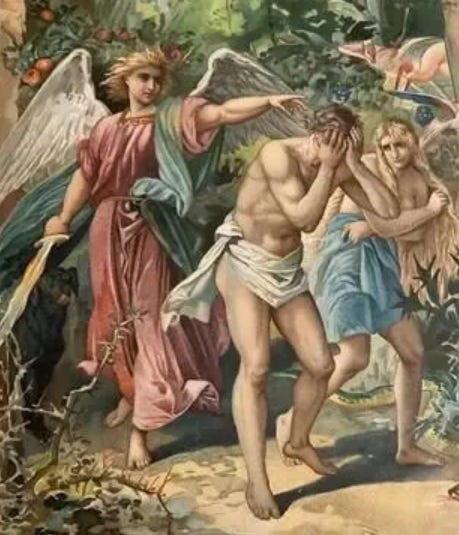
You don’t have to be a religious person to be familiar with the story of Adam and Eve. It would be difficult to grow up in America and not be exposed to some images, somewhere, of the two biblical ancestors—naked or clothed, with or without snake, with or without apple. It’s an easy, common reference point. Everyone knows the story.
Except, everyone doesn’t really know the story. A lot of people aren’t aware that there are two distinct creation narratives within Genesis—two different stories that were stitched together without much effort at reconciling them. Or any, actually.
In the first version, which occurs in Chapter One, humankind is created in a single event, after all the other creation is done: “Male and female he created them. And God blessed them and God said to them: Be fruitful and multiply and fill the earth and subdue it.” Job done. And it was evening and it was morning, the sixth day.
The second story starts in Chapter Two, at Verse 4. The first three verses seem to continue on from Chapter One, talking about God blessing the seventh day and hallowing it, and so on. But then, all of a sudden: Rewind!
“These are the generations of the heavens and the earth when they were created, on the day that the Lord God made earth and heaven.”
So, back to the beginning we go.
In this version, as far as I can tell, all of heaven and earth seem to be created “on the day,” in a single day. A lone man is then created from the dust. Life is breathed into him, and he’s placed into a garden by himself (no garden back in Chapter One—and no lonely, solitary man). Now we have Eden, and the Tree, and the prohibition about eating from the tree. And finally, in Verse 18, God decides to give the man a “helpmate.” He puts the man to sleep, takes a rib from his side, and creates a woman.
How do you reconcile two stories that contradict each other, if you were raised to believe that both are true? You just…do, I guess. You don’t think about it. Or you analyze, you interpret, you weave your own stories around the whole thing to help explain it. You make it make sense. Or, if that doesn’t work, you trash the whole thing as myth and nonsense, and you start reading existentialist philosophy.
However you deal with it, the fact remains that while these stories have been given to us (by God or by our ancestors), they are ours to make sense of.
And since they’re ours, there’s something I’ve been wondering about…
Every painting I know of those early chapters shows Adam and Eve as full-grown adults. They may be naked (Chapter Two), or they may be slightly clothed (Chapter Three), but they are adults. The events that happen to them in Chapter Three, where they eat from the forbidden tree, gain knowledge, become ashamed of their nakedness, hide from God, are cursed by God, and are driven out of Eden forever (whew—that’s a chapter!), all seem to happen in a single day. Is it the same day they were placed in the garden? The day after? Two days? A year?
It doesn’t say. In fact, nothing is ever said about their ages. Theologians and artists for centuries seem to have decided that Adam and Eve were created as grown-ups and that they existed as grown-ups in the garden for some undetermined period of time. Presumably they began aging once they left the garden, although I’m not sure anyone actually says that.
I have not made a rigorous study of this, as you can tell. I am neither a theologian nor an artist.
I do, however, have notes.
As a Member of the Tribe and a god-wrestler in reasonably good standing1 , not to mention being a writer-type who approaches biblical text poetically rather than, say, journalistically, I claim the right to kibbitz, as the grandparents used to say, and to reframe the story for myself. You, of course, are free to interpret things differently, or to ignore and dismiss what follows as mad ravings or a silly thought-exercise. To each their own.
So.
What would we think of this story, I wonder—what would the story mean to us—if Adam and Eve had been created as children—infants—and if they had aged over time like normal humans within that garden? What would the eventual eating of the apple and the gaining of knowledge—at adolescence—mean and symbolize to us—that knowledge of life and death, that awakening of nakedness and sexuality? I think we would see the story not as a tragedy—some “original sin” that cast us out of God’s grace—but simply as an allegory of growing up.
When we’re young, we think we can play and play forever, but we don’t know that our time is limited—that we sing in our chains, as Dylan Thomas put it. We think we can live on, unchanged, for eternity. We think we can romp through the world like little gods. And then we learn.
That’s how I see this story. Adam and Eve leave the garden because they must, because they are no longer children. Just like all of us. He must work and she must bear children—because that’s just what happens to us. Once we learn how the world works and who we are, we take on responsibility for it, and for ourselves, and for the people around us. And that means leaving the garden.
How do we know that humankind has been given responsibility for their moral actions? Look at the next generation and the first act of murder. If I believed in anything like “original sin,” it would be that moment—Cain killing Abel.
In Chapter Four of Genesis, older brother Cain becomes envious of younger brother, Abel. Before he can even plot and plan, God intervenes—kind of. He does not stop Cain, but he warns him. He says: I see you. I see that sin is waiting at the door for you, and I see that it wants you. But you can rule over it.
You can rule over it. The choice is in your hands.
It’s almost as though God says to humankind, “you asked for this.” You decided to leave the garden of childhood. You wanted to know the difference between right and wrong. Now you know it. So, it’s on you to behave accordingly.
We see the same sentiment eons later, when the Israelites gather at Mount Sinai to receive The Law from God after being freed from slavery2. Does God say, “you must obey these ten commandments?”
He does not.
God says: “Behold, I set before you this day a blessing and a curse: the blessing, if ye shall hearken unto the commandments of the Lord your God, which I command you this day; and the curse, if ye shall not hearken unto the commandments of the LORD your God, but turn aside out of the way which I command you this day (Deuteronomy, 11:26-28).
The choice is in your hands. You have always known that murder is wrong. Now I’ve set it in stone for you. Don’t say you haven’t been told. Behave accordingly.
You can take that as the Word from on high or you can take it as a founding myth of our people. Either way, I’m fine with it. I don’t want to be a child forever—ignorant, brainless, unable to make decisions for myself, and eternally under the thumb of some terrestrial or cosmic father. Not even if it’s a soft and kindly thumb. I don’t want someone else to decide, and my job is simply to obey. I’m happy that I left the garden and set out to see the world in all its joys and sorrows. I like being a grown-up. I don’t mind carrying the responsibility to behave accordingly. It’s not that hard, most of the time.
But when we don’t behave well—or, rather, when others don’t behave well and we suffer because of it, why do we wring our hands and look heavenward? Why do we say things like, “Where was God in the concentration camps?”
Did God promise to protect us from each other? I must have missed that.
Wasn’t God in the same place he’s always been? The same place he was, back when Cain was plotting the first murder? Watching and warning but letting us be free, letting us make the adult decisions we insisted on making once we took that first bite of knowledge?
The problem isn’t up there; it’s down here.
There’s an old, Talmudic story about two rabbis who are arguing about a point of law. One of them says, “if the law is what I say it is, let that tree prove it.” Immediately, the tree drops its leaves. The second rabbi says, “Pfft. That doesn’t prove anything.” So, the first rabbi says, “if the law is what I say it is, let that house prove it,” and boom: the house collapses. Same response from the second rabbi: that proves nothing. The first rabbi says, “All right, then. If the law is what I say it is, let God himself prove it.” A voice from the heavens thunders down that the first rabbi is correct. And the second rabbi says, “you stay out of this!”
The law may have been given, but it sits here now, with us. It’s our job to figure it out.
There’s another story, about a man who lived by a river. Here’s a lovely version of it, from The West Wing.
Whatever faith tradition or philosophy we believe in, we are not bereft. We have what we need to be fruitful and multiply, to rule over sin, and to reap the blessings that the world makes available to us.
What the hell are we doing here?
“Wrestles with God” is the literal translation of the word “Israel.”
Yes it is up to us and we have made a mess of it. Better start building the ark…..if you think you deserve to occupy it.
The thought of Adam and Eve as infants growing up in Eden gives a whole new argument for why women and not men should be in charge. Females mature faster than males in cognitive and emotional areas during childhood and adolescence. Studies show that girls' brains optimize neural connections earlier, particularly in areas regulating emotions, decision-making, and impulse control, leading to earlier maturation. I would argue that the first sin was the unwarranted arrogance of Adam to think that he, not Eve, should be in charge.