
Your Beach Read
Take a chance on me

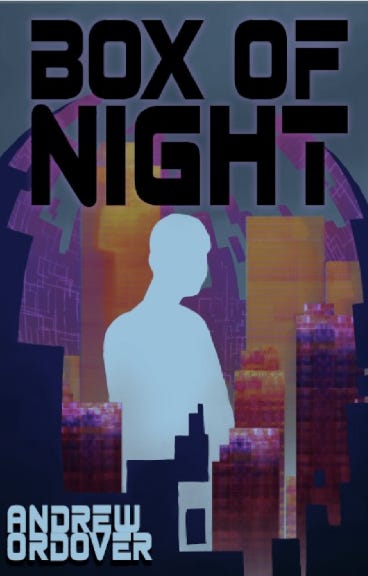
Summer is here, and if you need a book to take to the pool or the beach, allow me to not-so-humbly recommend my own novel, Box of Night.
What is it? It’s partly a mystery and partly a near-future dystopian thriller, with a little meditation on the nature of reality thrown in for kicks. It’s about the future of video games, and the changing global climate, and the opportunities and threats of generative AI. It’s about corporate tyranny and the struggle to be a person. It’s about fathers and sons. It’s about art.
Are you still uncertain? On the fence? Across the yard from the fence, hesitant to even approach the fence? That’s all right. I hear you. I get it.
Here’s what I’ll do. I’ll give you the prologue and the first two chapters, here on Substack, right now, absolutely free. If you like the writing, please consider supporting an independent author and buy a copy or three. If you don’t like it, well, no harm done. On to your next newsletter.
IS THAT A DEAL OR WHAT?
If you decide to take the rest of the ride, you can order a paperback or Kindle copy right here. And I hope you will.
Until then…enjoy!
Box of Night
[new game]
Suddenly he is deep in a forest. The trees are tall and thick, the light is dappled, the greens are deep and rich. The air is thick with sound: birds, cicadas, small things rustling in the leaves.
Check.
No smells, though. Still no smells. He reaches for his phone to make a note, but he can’t find it.
Right. Fuck.
Do we need to rethink phones? He’s gone around and around with User Experience, but he can’t make a note about it now; he’ll just have to remember.
Good luck with that. He doesn’t even remember logging in. Which is strange. What was he doing right before this? It’s the middle of the day. He must have had a reason.
He looks around, as if something in the trees might remind him, but the trees have nothing to say. They stand mute: three shapes, three shades, three ideas iterated endlessly. You’d have to look carefully to notice.
Then he hears something—a rustling in the undergrowth. He smiles—He knows that sound. He’s the one who required it—demanded they bump up the volume to help players catch the clue. In the real world, you’d never hear it. Big cats are too stealthy, too good. You’d never have a chance.
Well, he’s here now, and there must have been something in the sequence he wanted to review, so he might as well walk through the thing. The gun is the goal, sitting on a pedestal in the clearing. You have to know how to get there. He checks the trees to see if the blaze marks are clearly painted—clear but not too clear. Semi-blazing blazes. This isn’t for children.
He looks around and finds the orange splash. It’s well-placed. You do have to look for it, but it’s not impossible; it’s not unfair. He follows the marker and the next three, and there it is—the big gun perched on top of the stone pedestal in the middle of the clearing. Totally artificial and ridiculous, but the beta testers said they liked it. They loved the garishness of it in the middle of the realism. Maybe that’s why the team backlogged odors for the alpha, though he still thinks that’s a mistake.
The gun, though—the gun makes him smile. It’s big, and it’s golden, and it sits up on its stand in glorious display, with a shaft of light shining down on it. He feels exactly how a player would feel at this point, with the tiger closing in and the light starting to fade, and the trees looking all the same, all around. No actual angelic choir singing, but that’s the feeling, and it’s right on the nose. He steps towards the gun—
And stops. Something is blocking his way, but there’s nothing there. He lifts his hand and pushes, but the air…what is that? It kind of pushes back. He can’t move into the clearing. Some kind of bug. Damn it.
He walks a few steps to the left and tries again, but the same resistance pushes back on him. It’s like a force field in a movie. It’s everywhere, and he can’t push past it.
What the actual fuck?
He starts moving around the clearing, testing and touching as he goes. He can’t get to the platform. He can’t even circle it. The resistance extends from the clearing straight out into the woods. It’s a wall—an invisible wall that wasn’t in the specs. And the tiger is coming. The tiger is here. He can hear the amplified breathing—the amplified breathing he specifically requested to pump up the adrenaline.
And boy, is that working. By now you should be at the gun, trying to figure out how to get it off the stand and then how to load it. You should be counting your seconds.
Well, this is a fucking mess, isn’t it? When did all of this happen?
He turns around and spots the tiger, still hiding in the underbrush, audible and just barely visible. Darshi’s team did a great job. He should give them an extra bump for this. Meanwhile, time to get out and log this defect.
He reaches for the button on his belt—the one digital element they decided to add to the player’s real-life clothing—but it’s not there. He feels around his waist for it, but it’s nowhere.
That’s not good.
Where else did we talk about putting the kill-switch? Pockets? Pockets—because there isn’t always a belt. He checks everywhere, but there’s nothing. Not in his pants, not in his shirt, nowhere. So how is he supposed to…
He hears the tiger start to move from its hiding place. This was another embellishment—making it break cover and take a second position, more visible, before crouching and striking. Not realistic, maybe, but it definitely ups the fear factor. And he can feel it, even knowing the whole thing’s fake.
He’s looking at the tiger now, his own back pressed up against the invisible wall. His rational mind is annoyed about the wall and annoyed about the lack of an off-switch and annoyed at his own adrenal glands for pumping more and more of the hormone into his bloodstream, even though he knows there’s no threat. But the rational mind can’t compete with adrenaline, can it? The body thinks before the mind. That’s the magic of how we make it work. And isn’t it amazing?
Amazing. Yeah. His heart is hurting, it’s beating so fast. He should really have a thought or two about that—a rational thought about whether this is completely safe for players. But there’s no space for thinking anymore, and when the tiger strikes, it’s too late. There’s only teeth, and terror, and him: screaming.
1
It’s been a long time since Mr. Fox has been in the city. Of course, he’s only Mr. Fox when he’s in the city, so in some ways, he never left. Out in the country, he has his own name—his real name. He lives quietly out there, and he likes it well enough. The years stretch out and yawn like a cat in the sun. Lonely, but safe. He likes it well enough…until the money runs out.
And then, as if they can read his mind, they call him back to work. He puts on Mr. Fox like he puts on a suit, and he takes the dirty bus across the dead fields to the place where the money lives.
Fox doesn’t change much from visit to visit, but the city does. He can see it from a distance before they go through the tunnel. Construction cranes everywhere, though what they’re building, he can’t tell. From that distance, it looks like the city has been thriving. Thriving and dying at the same time, probably—creation and destruction keeping pace with each other. It’s not a dance he enjoys, which is why he prefers his table in the corner, where he can nurse his drink and watch from afar.
The bus slips into the long tunnel under the river, and now there’s nothing to see but white lights on walls, flashing rhythmically as they pass, and nothing to hear but the hiss of the tires on the roadway. But he knows what’s next. They’ll emerge into the blinding light of the city, injected straight into its veins, with busy cars and busy people whizzing around and silver buildings towering over them. And pushed to the sides of the road? Piles of garbage, ruins of old buildings, and useless people—the ones who aren’t busy, the ones who have nowhere to go. They get shoved to the side like ashy snow so that Commerce can make its way.
You can be the plow, or you can be the trash, thinks Fox. That’s what life comes down to. He’s seen it all and so have the commuters. It’s barely worth watching.
And they’re not, Fox notices. Most of his fellow passengers aren’t looking at the flashing lights outside the bus. Most of them are wearing virtual reality visors—playing games, reading books, watching movies, or doing work. He can see a few hands moving in laps, doing the finger dance that makes things happen on the little screens in front of their eyes. Others are looking at old-fashioned tablets or phones. He doesn’t blame them. It’s not an interesting trip, and most of them have taken it a hundred times. They’ve seen this movie.
Except this time, it’s different. For Fox, at least, the arrival is a surprise, because this time, he sees nothing. Shortly before the bus leaves the tunnel, Fox hears the grinding of metal and sees large plates lift up over the windows on the outside of the bus. They settle into place with a loud clack. Now he’s in a closed, metal tube with flickering, pale lights. Blind and clueless and hurtling forward.
After a while, there’s a bump and a change in rhythm, and maybe the thinnest line of light coming between the metal and the window. He guesses that they’ve left the tunnel. And then he knows.
He knows because, almost instantly, he can feel the bus being hit—pelted with hard objects like rocks. He can hear muffled yelling from outside the bus. Angry voices. Loud voices. He can feel hands whacking the bus as it slows down on the narrower streets just outside the tunnel. They’re trying to rock it, maybe overturn it. But the bus keeps moving, like a tank. Impenetrable. The violence ebbs as they get deeper into the city, but the metal never retracts from the windows—not even when they reach their destination inside the depot.
Fox wonders if this new ugliness is connected to why he’s been called. He hopes not. He doesn’t like the big jobs—the high stakes jobs. He likes to do good work, clean work, and then take his cash and go home. Whatever has happened to the city, it’s too much for him. Too big and too messy. But he suspects that whatever they’ve called him for, it’s part of this.
Too pessimistic? Maybe. But it’s his job to see what’s real and not get fooled—to see clearly, make the call, and then act. It’s what they trained him for.
He wonders if he should have said no. Then he catches a glimpse of his reflection in the black window and laughs. Funny ideas in the dark.
The bus hisses and stops and sighs a little, and the doors swing open. Fox stands up and grabs his bags, and he waits his turn to disembark. When he steps down off the bus, he’s surprised to see two armed men standing on either side of the door, guarding it. They’re big men, holding big weapons, and they wear helmets with darkened visors.
There’s a fleet of cabs and shuttles waiting at the bus bay, and most of the passengers move from the bus to another vehicle as quickly as they can. The soft animals leave one hardened shell and climb into another, and then, one by one, they zip off in different directions. Mr. Fox is the only one left standing.
The smell hits him first: stale, sour, and heavy—the smell of too many people existing in too small a space. Humans not moving, air not moving. No wonder people want to get from the bus to the car quickly.
He pulls a piece of paper out of his pocket and checks an address he’s written down, and he starts to walk, odors be damned. He’ll need to reacquaint himself with the streets.
The staleness and heaviness follow him out of the depot and into the open air. The whole city feels like a closed room. Eyes track him as he walks down the street. A couple of people start to follow him but then think better of it. He notices, but he doesn’t slow his stride. The city may not be what it used to be, but he’s still the Able Fox; he knows how to make people think twice. He arrives at his destination unmolested.
2
“Dear man!” Jennings says, striding over to him and shaking his hand with both of his large mitts. “It’s been too long.”
Fox disagrees. It’s been exactly long enough.
Jennings takes the overnight bag from him and dumps it on top of a long conference table, leading him into the room. It’s a big space, with ugly, modern furniture and an inexplicable color scheme of nauseating greens. Fox can’t imagine anyone sitting in here happily for meetings of any length. But maybe that’s the point.
The windows are worth the trip, though. Big picture windows line the entirety of the two corner walls, from waist-level all the way up to the ceiling, with the sun beaming in to warm up the room. The skyline looks beautiful from here. Which is strange, because ten minutes ago, when Fox was outside, it was grey and rainy. And where are all the construction cranes?
Jennings catches him looking and laughs. “You’re not crazy,” he says. He walks over to one of the windows, unlatches it, and pushes it open. The big window rotates on its axis, and suddenly, grey sky and angry street noises pour in. “It’s all video,” the big man says. “Insulated, of course, now the weather’s crapped out on us.”
Fox walks over and touches the fake window. “Amazing,” he says.
“Isn’t it?” Jennings says. “They’re just hitting the market now. Everybody wants them.”
Fox tries to lean out to see what’s going on down there, but Jennings reaches past him to shut the window. Fox can feel the pressure in his ears.
“Limited library of images for now,” says Jennings, “but you can imagine. Scenes from around the world, pictures of your grandkids, sunlight, snow. Porn, probably.” He chuckles. “Very distracting if you ask me. More power to them, but not in my office.”
Which is…where, exactly? Fox has no idea. Jennings does have an office somewhere, and an assistant named June who manages travel and logistics, but Fox has never seen it, or her, and has no idea where they are. They always meet like this, on a job site.
“So, what is this place?” Fox asks.
“Did you not get the packet?” He frowns, pulls out his phone, and barks into it, “June? Did Fox not get his packet?”
There’s a muffled response that Fox can’t make out.
“Well, that’s not helpful, is it?” He rolls his eyes and pockets his phone without another word. “Sorry about that. It’ll be in your inbox. You can catch up at the hotel.” He places his big, meaty hand on Fox’s arm and guides him out of the conference room to show him the main floor. “This is Westerly Tech. Paul Westerly, aging wunderkind, CEO—DOA.”
“Ah,” says Fox.
“We’ve sent most of the staff home. Usually quite a beehive of activity, I’m told.” Jennings guides him to another corner of the building and opens the door to what was clearly the late CEO’s office. He gestures to the room grandly. “They found Westerly in here yesterday morning, eyes goggling out of his head, stone dead. Heart attack.”
“So?”
“Thirty-seven years old, fit, no history of heart disease. So…suspicious.”
Jennings walks into the office and Fox follows him.
“Okay,” Fox says. “But that’s cop work. What are we doing here?”
Jennings nods, grabs some large papers off the desk, and lays them down on a small table in the middle of the room.
“This is what we’re doing here.” He points to some sketches and designs on the paper. “It’s a prototype. Like most of what you see around here. Highly secretive, highly protected, reams of NDAs, et cetera. One working version in existence. And now it’s gone. Code wiped off the servers, records scrubbed. Vanished. Along with a couple of key employees.”
“That still sounds like police work,” Fox says. “Pretty standard stuff, isn’t it? Corporate espionage?”
“And murder,” Jennings reminds him. “Potentially.”
“Potentially murder, fine. Still…”
“Why us?”
“Exactly.”
Jennings lowers his bulk into a large, comfortable chair. “There are concerns,” he says carefully. “Certain parties have concerns about this intellectual property, and they want it recovered and delivered to them. Quickly, with a discrete, surgical, and off-the-books investigation. That’s why us. Why you, rather. Which makes it…pretty standard stuff in our world.”
“And those certain parties?” Fox asks. “Government? Corporate?”
“Need to know,” Jennings says. “As usual.”
“Right.” Fox picks up one of the big pieces of paper and looks at it. “So, what is it? Some kind of video game?”
‘Something like that.”
“Jesus,” Fox says. “The things people get obsessed about.”
“I’m told it’s worth quite a lot of money. Billions, perhaps. A literal game changer,” he says, a bit derisively.
“So, find the runaway employees, find the game?” Fox says.
“If they still have it. If they haven’t sold it, or traded it for something, or defected to North Korea, or God knows what,” Jennings says.
“North Korea?”
Jennings shrugs.
“And the thieves?”
“What you do with them is of no interest.”
“All right,” says Fox. “Do we have anything on them? Emails? Files? Notes?”
“Wiped,” says Jennings. “This was done carefully.”
“Hm,” says Fox. “All for a video game.”
Jennings laughs quietly. “Video game may be selling it a bit short.” He heaves himself up out of the chair and walks towards the big desk. “I said there was one working version. There was actually another—an early model locked up in a safe. It has been made available to us. Come take a look.”
He reaches into a cardboard box and pulls out a piece of machinery for which the word “contraption” might have been invented. There’s a metallic and fabric headband, very hand-fashioned, with a nest of wires and perhaps electrodes jutting out from around the band, and what look like two or three long, USB cables.
“Are we reanimating dead people?” asks Fox.
Jennings turns the thing in his hands, examining it, and then yells out, “Mister Trofimov!”
“And where’s the screen?” asks Fox.
Jennings chuckles. “Where, indeed?” he says.
A shaggy-haired young man sticks his head into the office, as if afraid to commit his whole body to the room. “You need me?” he asks.
“If you don’t mind, dear boy. Thank you.” Jennings raises the contraption up to show his helplessness with it.
“Oh, sure,” the young man says. He comes more fully into the room, where Fox can get a better look at him. He could be anywhere from twenty-five to thirty-five—shoulder-length, curly hair; a lean, triangular face; little, round glasses; and a lean, triangular beard. Typical hipster code-monkey in clothing and affect, but maybe a little tentative now that he’s alone in the office with two older strangers.
And with his boss dead, Fox adds to his mental column of figures, to be a little more generous.
“This is Patrick Trofimov,” Jennings says. “He’s been gracious enough to be on hand for us today.”
“Paddy,” the young man says, shaking Fox’s hand.
“Mister Trofimov is quite a brilliant young engineer, I’m told. He can explain this whole thing to you, far better than I can,” says Jennings. He hands the contraption to the young man and then gestures to Fox and says, “Come—sit.”
Fox sits in the CEO’s big desk chair, because that’s where Jennings has waved him—wondering too late if that was where Westerly had been found dead. Trofimov brings the crazy headgear over to him and holds it up for him to look at.
“This isn’t what the new set looks like, obviously,” the young man says. “We had just locked the final design before…you know. What they took doesn’t need all this hardware and wires and stuff. It’s just a basic, white helmet, everything built in. That and the box.”
“Okay,” says Fox. “But what is it?”
“I can show you,” Trofimov says. He fits the band over Fox’s head and starts sticking electrodes around his forehead. “The games we make now—stuff we’ve had for years, really—they’re what we call immersive. Where you put on a visor or goggles or something, and some haptic gloves, and you get to manipulate a virtual environment. You’ve played those.”
“No,” says Fox. “But I know what you mean.”
“Well, we’ve been working at that level for years. Most of my life, actually. This here is just a step beyond,” he says.
Trofimov plugs wires into a metal box that Jennings has produced and then flips a switch on the box.
“Beyond in what way?” asks Fox, but before he can get an answer, he’s…gone. He flails around and jumps to his feet. He’s no longer in the office, no longer with Jennings and Trofimov. Instead, he’s in some brightly lit, crazy, outdoor environment, bright blue sky, with a flight of white steps leading up to a platform and a series of large, colored blocks at his feet. He looks around and is amazed at how complete and far-reaching the environment is. He reaches up to touch his forehead. There’s no trace of the device.
“This is crazy,” he says, but he appears to be alone.
One of the blocks at his feet shimmers and wobbles a little bit, as if to call attention to itself, and then a giant arrow appears, hovering in the air near the top of the staircase. Fox hears a series of beeps, and then one long beep. The arrow disappears, and some circus music starts playing…somewhere.
Okay, says Fox. I get it. Jennings better make sure I don’t trip over something and break my neck.
He picks up the big block that was shimmering, and he carries it up the steps, depositing it where the arrow had been pointing. He hears a happy ping somewhere. The realism of the whole scene, even as cartoonishly as it’s depicted, is impressive. He can sense the rough ground beneath his feet. His hands feel the texture of the box. His body acknowledges the weight of lifting something and lugging it up steps. He is moving through real space.
He trots back down and carries up three more blocks, just to get the full experience. Then he looks around, wondering how he gets out of this thing.
“Al right!” he yells. “I get the idea.”
And just like that, he’s back at the desk, in the chair.
“Jesus!” he says, jumping, shocked by the quick return to reality.
“Get the picture?” asks Jennings, with a little smile on his face.
“I just said so.”
“Did you?” the big man says. “Funny.”
“You couldn’t hear me?” asks Fox.
“No, my dear man,” Jennings says. “That’s kind of the point.” He waves Trofimov over and reaches for a mobile phone that’s in the young man’s hands. “See for yourself.”
Fox takes the phone and sees that Trofimov has been recording him. He presses play and watches a video of himself sitting absolutely still—doing nothing, saying nothing, moving not even a finger—right up until Jennings turns the game off, at which point Fox comes to, yelps, and Jennings says, “Get the picture?”
“What the fuck?” Fox says quietly.
“I can’t go into details,” Trofimov says. “Legally. But the basic idea is that we hijack the signals feeding input into your brain and then replace them. All of them. Wind on your skin, light in your eyes, everything.”
He pauses for a second. “Well,” he says, unable to resist the details, “We take all the input, but we haven’t re-routed everything yet. Some stuff got delayed. Sight, sound, touch—that’s all complete. Smell and taste are still on the backlog.”
“Anyway,” Jennings says, prompting the younger man.
“Anyway. Right. So, we feed our signals into your brain, then we hijack the output from your brain, the things that tell your body to move and stuff, and plug that back into the game, too. That’s what keeps you safe, so you don’t fall out of your chair. The whole thing creates a circuit; one feeds the other, the other feeds back. But…I mean, even that probably violated my NDA.”
“That’s all right,” says Jennings. “We have special dispensation.”
“And it works?” Fox says. “The brain can’t tell what you’re doing?”
“Could yours?” says Jennings.
“The brain…I mean, it’s just a bunch of electrical signals bouncing around a dark room, basically,” Trofimov says. “All it knows about the world outside is what our senses tell it. So, we just tell it something different. That’s all we’re really doing.”
“Thank you, Paddy,” says Jennings. “That will be enough for now. Let Mr. Fox and I have a moment, if you would.”
Trofimov nods a little, bows a little, all awkwardly, and trots out of the room, pulling the door closed behind him.
“All we’re really doing?” says Fox, eyes wide.
“If youth but knew,” says Jennings.
“Anyway,” says Fox, peeling the device off his head, “I can see why it’s worth billions.”
“Even if all it did was rainbows and target practice,” says Jennings, lowering himself back in the comfortable chair. “This is the concern. They could have stolen this version and cashed in. But they didn’t.”
“Why should they? Why steal the Ford when the Ferrari’s just sitting there?” says Fox, dumping the device back on the desk.
“Fair enough,” says Jennings, with a quick glance to make sure the door is shut. “However. Our employers believe what was stolen was not simply a more stylish helmet. They think it’s something significantly more.”
“Meaning?”
“Meaning the new games they’ve developed, the environments—they may be so realistic that if you woke up inside one of them, you’d never know. That you were there, I mean, and not…here.” He waves at the world around them.
Fox nods. “That would be…significant.”
“If it’s true, our friends find the implications unpleasant to consider. Especially with every two-bit hacker writing code for it on the open market. It’s a cat they would very much like to see stuffed back into the bag, so to speak.”
“Mm,” says Fox.
“Mm,” Jennings agrees. “So. Go clean up, get some dinner, and read over the file. If you need anything more to get started, reach out to June.”
“Will do.”
The big man stands up and smooths his suit. “Let’s get this buttoned-up fast, if we can. Yes?” he says. “I don’t like this thing being out in the weather.”
And with that, their meeting is adjourned.
Well, that’s it. The prologue and the first two chapters. I hope you enjoyed it, and I hope you’ll order a paperback or Kindle version of the book here—for yourself, for your friends, for putting into one of those cute, free library boxes you see everywhere now, or for handing out to random people on the street.
Have a great summer!
Highly recommend!!